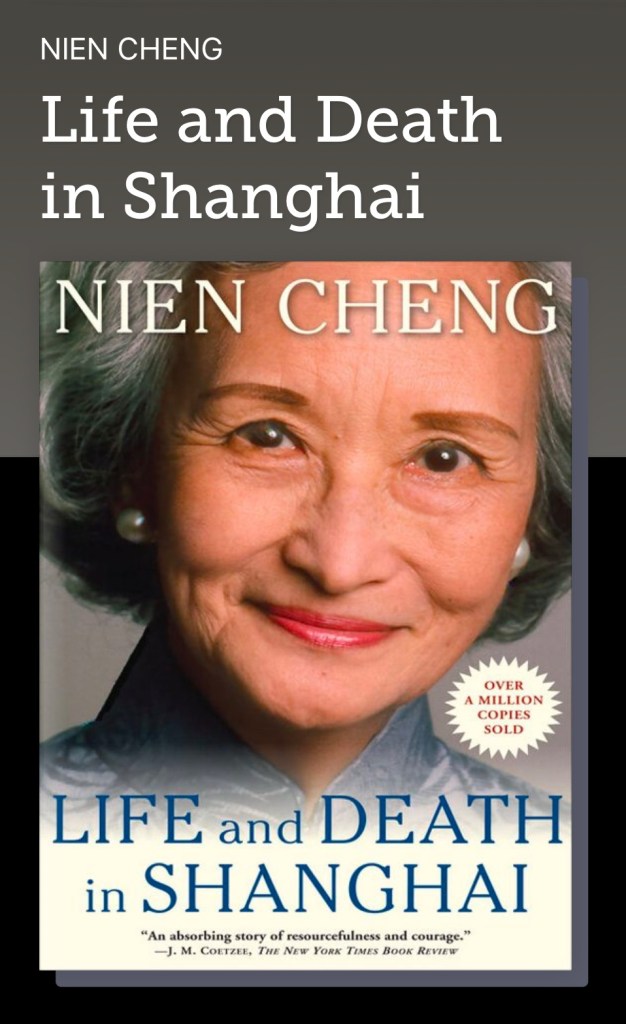
Summary: First person account of a Shanghainese woman falsely accused of being a foreign spy during the Cultural Revolution and subsequently jailed for 6.5 years before being rehabilitated immigrating moving to America. Illustrates how Chinese culture and morality was in constant flux depending on publicized Community Party ideology/agenda and how the people’s personal rights and freedoms were subsequently granted or restricted by those in power.
Personal Takeaways:
- “Right” and “Wrong” being defined by the government’s agenda made morality extremely subjective. In the end, sinful people take advantage of what’s permissible for personal gain and advancement. No sense of justice since everything was relative to current political policy and climate.
- Didn’t realize the extent to which people have no personal rights or policy and how much they’re influenced by government control.
- Communism/socialism was just a facade- there was no true egalitarianism as those in power along with their associates always had access to the best resources.
- Had no idea about the political factions within the CCP itself and how political wars created casualties of everyday citizens.
- Interesting to observe the wisdom of the author in navigating different traps set by her interrogators or observers and her wisdom and tact in circumventing certain landmines that would obstruct her goals.
- Pleasantly surprised by the author’s Christian faith and how God sustained her through physical and psychological abuse, and to see hear her testimony sprinkled throughout alongside her examples of personal integrity. She did an excellent job of submitting to and honoring government authority while entrusting herself to God.
History & Personal Relevance:
- Kuomingtang (KMT) originally ruled China until it lost the Chinese Civil War to the Chinese Communist Party (CCP) in 1949, after which they withdrew to Taiwan
- 爺爺 moved to Taiwan in 1948 when he was 14. Likely in his teens. 奶奶 was born in Taiwan. He was the oldest and had 3 younger sisters. He originally had a twin who may have been younger.
- 爺爺’s dad originally had a cloth store. He graduated from junior high school and became an elementary school teacher. In Taiwan he took night school in accounting to become an accountant with the government. He went on a boat with his uncle to Taiwan when he was 14 from Hangzhou. His uncle asked yeyes ah ma if they wanted to see how it was and after they went to Taiwan they weren’t able to come back. At that time they could only write letters to his friend in Hong Kong, and they would help him send it to Hangzhou. It wasn’t until college that yeyes friend in HK called yeye to tell him his mom passed and he was really sad. His HK friend was a businessman and would travel to China to see yeye’s mom. Yeye would get his friend to give money to his mom. In 1990s the two sides opened up so they could visit his relatives in China. His first time back was bringing youngest aunt since everyone else was in school. Yeye asked his younger sister about the cultural revolution since on the news the kids had to persecute their own parents. When Yeye asked his sister if they did it, they said everyone did that.
- Bobby’s 奶奶 hid some books and pictures under the floor because she knew they would burn them.
- 奶奶 remembers having to hide in the shelters during the Japanese occupation of Taiwan. Some Taiwanese have ideas and thinking influenced by Japanese because of that time. She was born in Taiwan but several generations ago her ancestors also came from China. She’s 12 years younger than 爺爺.
- 爺爺 met 奶奶 at work. 阿媽 was the cook at 爺爺’s work so nai nai would often visit her. Yeye thought she was pretty so he would pursue her. She was only 17 when she got married and 18 when she gave birth.
- 公公 was born around 1928. He was 9 when the Japanese invaded in 1937.
- 公公 was in the Air Force and flew his plane to Taiwan after the KMT lost the war in 1949. Probably when he was 21. His family was wealthy landlords and they had a restaurant that would host all the wealthy and political elite.
- Yeye tried to bribe mommy to birth another son as backup and said he’d give her 10 diamonds.
- 婆婆 was born in 1934. Her dad was a high ranking government official under Chiang Kai Shek, who then became a mayor of two cities in Taiwan, and then a principal. I’m guessing she came to Taiwan around 15?
- Jack’s mom’s parents were teachers, and his grandpa was a principal. His grandparents were forced to go to struggle meetings to publicly repent.
- Mao Zedong launched several campaigns of varying successfulness before initiating the Cultural Revolution in 1966
- 公公 was homeless when he was 8 and the Japanese bombed them cause he couldn’t find his way back home.
- The Cultural Revolution initially was supported by optimistic youth hoping to gain advancement and improve livelihoods, denouncing foreign, intellectual, and capitalist thinking, but instead spiraled into chaotic and violent factions due to upstream political infighting, particularly due to the ambitions of the Gang of Four.
- During the 1970s China started relations with the United States and began opening doors to international influence
- Ironically, the policies that were denounced during the Revolution led to economic decline, and were reimplemented by subsequent CCP leadership
 Always Learning