The Power Pause, Neha Ruch

Summary: This book endeavors to reframe the narrative around career gaps taken to spend time with kids. It helps plan for a pause, thrive during the pause, and reenter the workplace after the pause.

Personal Takeaways:

  • You can use the gap to keep building your network and relevant skills to make the transition back to work easier. The gap can also help you figure out what you’re genuinely interested in. But you have to know how to position the value add well.
  • While it’s definitely possible to return to work after an extended break, the stats are that most people either don’t, or it’s really hard to, and if they do, they either have to “start over” with an entry level position, or they commonly take a drastic pay cut/lower position.
  • People generally prioritize flexibility, stress level, and then salary when considering a new role.
  • Don’t ever say you’re “just” a SAHM as to diminish your role.
  • It can be helpful to frame the time by beginning with “I get to…”, e.g. “I get to spend more time with my kids”, since being able to do so is a privilege and hopefully not an obligation.

Personal Relevance:

  • How do you spend your time when you’re not getting paid?
    • Cooking and testing recipes
    • Finding good deals
    • Sharing knowledge and recommendations
    • Helping people
  • What do I want in life? Why? Why? Why?
    • I want to make the best decisions for my family and give them the best. So that they will thrive (not suffer?) and I won’t have any regrets.
    • I want to maximize whatever God has given me – be it finances, relationships, energy, etc. Because I hate waste and I want to be a faithful steward. Because it makes me cringe inside when things are wasted.
  • How do you want to grow? What do you want to be remembered for?
    • I want to be remembered as someone who was always willing to help others. Authentic. Kind, understanding, sensible, a good listener, discerning, and gives sound advice. Slow to speak and slow to become angry. Someone who lived a quiet life but radiated joy. Inclusive, welcoming, and treated everyone well.
  • What do you want as an individual? (Personal goals). Noticing when people embody an energy or trait you admire or envy can often give you a clue.
    • Welcoming and inclusive. Patient and put others before themselves. Quick to serve. Takes initiative. Thoughtful and remembers things. Able to get along with many different people.
  • What do you want to achieve professionally? (Career goals)
  • What do you want to experience with your kids and your partner? When is my family at its best? What memories do I want my kids to have of their childhood? What are my family’s ideals, and is there anything in my life right now in conflict with them? (Family goals)
  • Picture an ideal day in your life three years from now. Describe what you see, including where you are, how your relationships feel, what you spend your time doing, who you spend time with, and how you take care of yourself
  • Write a letter from your future self. Imagine you are twenty years older and have experienced a fulfilling two decades as a mom. Write a letter from that future you to present-day you. Describe all that you have accomplished personally and professionally. Write about your well-being,
    your community, your professional or creative pursuit, and your family. Share your regrets, your most significant accomplishments, and where you are now.
Wild Swans, Jung Chang

Summary: Biography and auto-biography of three generations of Chinese women who go through life as concubine of a warlord and then doctor, a loyal Communist when the KMT were first defeated, and a youth growing up in the Communist era and maturing through its evolution and various leaders.

Personal Takeaways:

  • Really interesting how the author highlighted Mao’s propensity for deconstruction and chaos as a way to maintain control, harnessing people’s inherent vindictiveness and selfishness for his purposes. This was in contrast to Zhou Enlai and Deng Xiaoping who were more constructive with their leadership. Also really interesting to see the “kill or be killed” type of dilemma amongst the communist officials given mandates or quotas, and how it could lead to so many false or unjust accusations.
  • Didn’t realize how lowly concubines were viewed and how remarriage was looked down upon, especially when association meant your own status would be degraded.
  • Really interesting to see the initial contrast between the corrupt KMT and the Communists “liberators”. Especially the segment highlighting where either way the peasants were poor, but with the KMT it was in contrast to the extravagance of the officials.
  • Communism was meant to achieve an ideal state of socialism where no one would suffer and everyone would be cared for by the state, but it devolved into petty vengeance and chaotic factions due to peoples sinful nature and the desire for power/control above the ideals that it supposedly stood for.
  • Makes sense why the “back door” continued to be relevant when achievement-based “front door” means of getting things was discriminated against.
  • Didn’t realize how important family background was in determining social class for you and your future descendants both pre- and post-communism.
  • This book did a good job of highlighting just how pointless elevating the proletarian/peasant class was and also advocating thought reform through hard labor. Especially how ineffectual it was to try to run a government or administration without intellectuals or at least people who were literate.
  • Fascinating to have an insiders view on what would lead someone to pursue communism initially and how someone growing up with a deified Mao would be essentially brainwashed to take his word as it was.

Personal Relevance:

  • There were uncanny parallels between the loyalty and subsequent disillusionment that came with being a faithful communist vs. serving under Min in ICA. Especially through the author’s father’s life, you could see the progression of living for his ideals with integrity to being persecuted in spite of it just because he fell out of favor and because the leadership wasn’t actually about those ideals.
  • I wish I could go back in time to explain the conditions to my paternal grandfather. My dad told me he could never forgive his siblings for denouncing their parents, but these stories showed how it was either that or you give up the safety and security of your own family and children. And how luxurious it was not to even have to go through that in Taiwan.
  • It makes a little more sense how Jack’s dad is really skeptical towards ideologies and brainwashing basically, seeing how people were so blinded and how the philosophies were used as a control mechanism over the people.
  • China didn’t become more open til Jacks parents were about 7, when Nixon visited in 1972 and English became acceptable to learn. Around the late 1960s, intellectuals had been sent to the countryside, which is presumably how Jacks dad was able to get a superior education.
  • I wish I had more appreciation for Tiananmen Square and the historical significance when I visited. How it was the location of the first protests in 1976 and then 1989.
  • It’s actually really sad that so many of China’s ancient architecture, art, and relics were destroyed during the cultural revolution. I should appreciate seeing Chinese stuff in museums more. So much history lost. The book said basically just the nature remains.

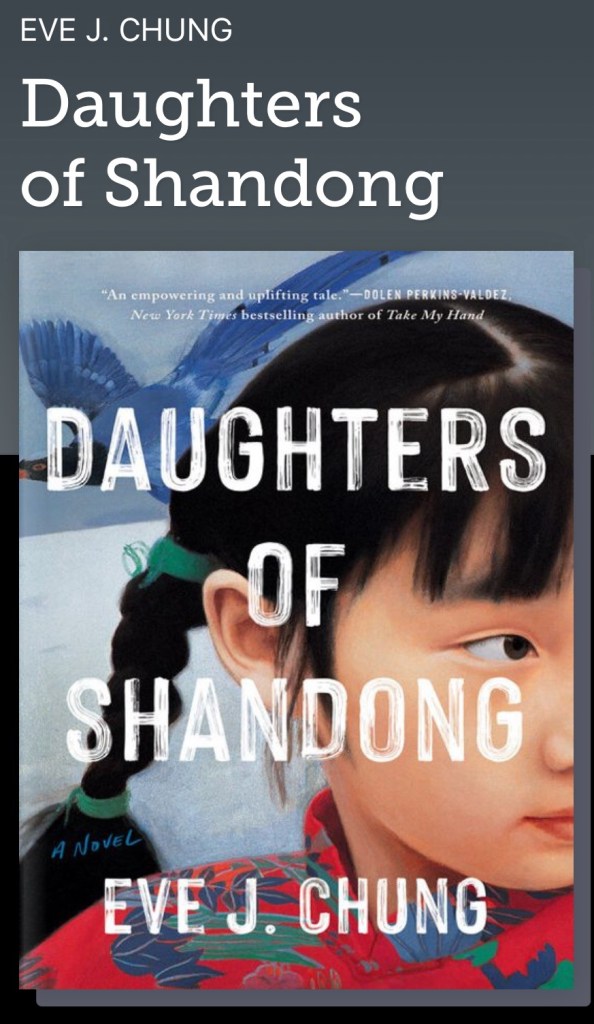
Daughters of Shandong, Eve Chung

Summary: The story of a mother and her daughters who are abandoned by their family to flee the Cultural Revolution. Details their escape and fight for survival from rural Shandong, to Qingdao, Hong Kong, and finally Taiwan. Highlights the impact of Confucian patriarchy on Chinese family dynamics and culture, particularly its impact on women.

Personal Takeaways:

  • Wives’ positions within families were only secured by their ability to bear sons; girls were viewed as useless mouths to feed and future debt to other families since they would one day leave the house and the best path for them was to marry well
  • Sons were valued for their future ability to provide for their families and because only they would be able to worship their families ancestors
  • Tang cousins share the same last name and treat one another as siblings since they would have the same family tomb; marriage with Tang cousins would be considered incestuous
  • Higher education (high school and above) was traditionally reserved only for boys if the family couldn’t afford sending girls, since opportunities for university education was maximized for boys to be able to provide for their future family
    • Only 大姑姑 went to university at NTU and studied sociology and 小姑姑 went to nurse school.

Personal Relevance:

  • Confirmed that only my parents are really responsible for worshipping the Yeh family ancestors because only my dad is a “Yeh”. This is a huge stronghold that seems like would be very difficult to overcome when thinking about my dad converting to Christianity.
  • Part of the significance of Jack’s grandparents forcing him to be a Cao may have meant that he was to provide for the Cao family rather than for the Zhang family
  • I am thankful to be raised in my current generation, apart from patriarchal influences and expectations, and to have been afforded the same opportunities as my brother, even if he is a “Yeh” and I’m not
  • It is significant that my mom was able to go to top universities since it would have been less common to be able to afford sending girls
  • “Sometimes, success is something that happens over the course of generations, something that is built upon life after life, each one opening a path so that those coming after can walk easier, farther” – Really interesting quote and very true, although I wonder if it’s so true for my brother and I haha because it seems like we haven’t necessarily walked farther, though it’s definitely been easier.
  • Makes sense why education is viewed so highly in Taiwanese/Asian culture since it is directly related to success and opportunities.
  • Makes sense why people who have experienced hunger and trauma want to horde or go to the extremes of saving up for a rainy day, or do stuff like fatten kids up just in case something bad happens again.
  • This book uses the term “denunciation rallies” instead of “struggle meetings,” which feels much more apt. Didn’t realize how violent they could be, especially when conducting land reform.
  • It was interesting how the book also portrayed the kindness and humanity of the cadres towards fellow peasants and workers in juxtaposition with their hatred and abuse towards the privileged.

Follow Up:

  • I wonder if my brother is aware of the cultural significance or obligations of being the only Yeh boy
  • I wonder if Jack’s mom’s parents practiced ancestor worship and if they believed that only Cao males could worship the Cao family ancestors
  • I remember Jack’s dad’s older brother is estranged from the family. I wonder how that impacted Jack’s dad in terms of familial obligation to provide for his own parents, if in a way he was essentially the oldest boy.
  • I wonder if Jack’s maternal grandma was ashamed or traumatized by her inability to bear sons and whether that contributed to the harshness with which they treated Jack’s dad when wanting to marry Jack’s mom. Why didn’t they force Jack’s aunt’s husband to also give Xiao Mei the Cao last name?

Life and Death in Shanghai, Nien Cheng

Summary: First person account of a Shanghainese woman falsely accused of being a foreign spy during the Cultural Revolution and subsequently jailed for 6.5 years before being rehabilitated immigrating moving to America. Illustrates how Chinese culture and morality was in constant flux depending on publicized Community Party ideology/agenda and how the people’s personal rights and freedoms were subsequently granted or restricted by those in power.

Personal Takeaways:

  • “Right” and “Wrong” being defined by the government’s agenda made morality extremely subjective. In the end, sinful people take advantage of what’s permissible for personal gain and advancement. No sense of justice since everything was relative to current political policy and climate.
  • Didn’t realize the extent to which people have no personal rights or policy and how much they’re influenced by government control.
  • Communism/socialism was just a facade- there was no true egalitarianism as those in power along with their associates always had access to the best resources.
  • Had no idea about the political factions within the CCP itself and how political wars created casualties of everyday citizens.
  • Interesting to observe the wisdom of the author in navigating different traps set by her interrogators or observers and her wisdom and tact in circumventing certain landmines that would obstruct her goals.
  • Pleasantly surprised by the author’s Christian faith and how God sustained her through physical and psychological abuse, and to see hear her testimony sprinkled throughout alongside her examples of personal integrity. She did an excellent job of submitting to and honoring government authority while entrusting herself to God.

History & Personal Relevance:

  • Kuomingtang (KMT) originally ruled China until it lost the Chinese Civil War to the Chinese Communist Party (CCP) in 1949, after which they withdrew to Taiwan
    • 爺爺 moved to Taiwan in 1948 when he was 14. Likely in his teens. 奶奶 was born in Taiwan. He was the oldest and had 3 younger sisters. He originally had a twin who may have been younger.
    • 爺爺’s dad originally had a cloth store. He graduated from junior high school and became an elementary school teacher. In Taiwan he took night school in accounting to become an accountant with the government. He went on a boat with his uncle to Taiwan when he was 14 from Hangzhou. His uncle asked yeyes ah ma if they wanted to see how it was and after they went to Taiwan they weren’t able to come back. At that time they could only write letters to his friend in Hong Kong, and they would help him send it to Hangzhou. It wasn’t until college that yeyes friend in HK called yeye to tell him his mom passed and he was really sad. His HK friend was a businessman and would travel to China to see yeye’s mom. Yeye would get his friend to give money to his mom. In 1990s the two sides opened up so they could visit his relatives in China. His first time back was bringing youngest aunt since everyone else was in school. Yeye asked his younger sister about the cultural revolution since on the news the kids had to persecute their own parents. When Yeye asked his sister if they did it, they said everyone did that.
    • Bobby’s 奶奶 hid some books and pictures under the floor because she knew they would burn them.
    • 奶奶 remembers having to hide in the shelters during the Japanese occupation of Taiwan. Some Taiwanese have ideas and thinking influenced by Japanese because of that time. She was born in Taiwan but several generations ago her ancestors also came from China. She’s 12 years younger than 爺爺.
    • 爺爺 met 奶奶 at work. 阿媽 was the cook at 爺爺’s work so nai nai would often visit her. Yeye thought she was pretty so he would pursue her. She was only 17 when she got married and 18 when she gave birth.
    • 公公 was born around 1928. He was 9 when the Japanese invaded in 1937.
    • 公公 was in the Air Force and flew his plane to Taiwan after the KMT lost the war in 1949. Probably when he was 21. His family was wealthy landlords and they had a restaurant that would host all the wealthy and political elite.
    • Yeye tried to bribe mommy to birth another son as backup and said he’d give her 10 diamonds.
    • 婆婆 was born in 1934. Her dad was a high ranking government official under Chiang Kai Shek, who then became a mayor of two cities in Taiwan, and then a principal. I’m guessing she came to Taiwan around 15?
    • Jack’s mom’s parents were teachers, and his grandpa was a principal. His grandparents were forced to go to struggle meetings to publicly repent.
  • Mao Zedong launched several campaigns of varying successfulness before initiating the Cultural Revolution in 1966
  • 公公 was homeless when he was 8 and the Japanese bombed them cause he couldn’t find his way back home.
  • The Cultural Revolution initially was supported by optimistic youth hoping to gain advancement and improve livelihoods, denouncing foreign, intellectual, and capitalist thinking, but instead spiraled into chaotic and violent factions due to upstream political infighting, particularly due to the ambitions of the Gang of Four.
  • During the 1970s China started relations with the United States and began opening doors to international influence
  • Ironically, the policies that were denounced during the Revolution led to economic decline, and were reimplemented by subsequent CCP leadership

Flowers

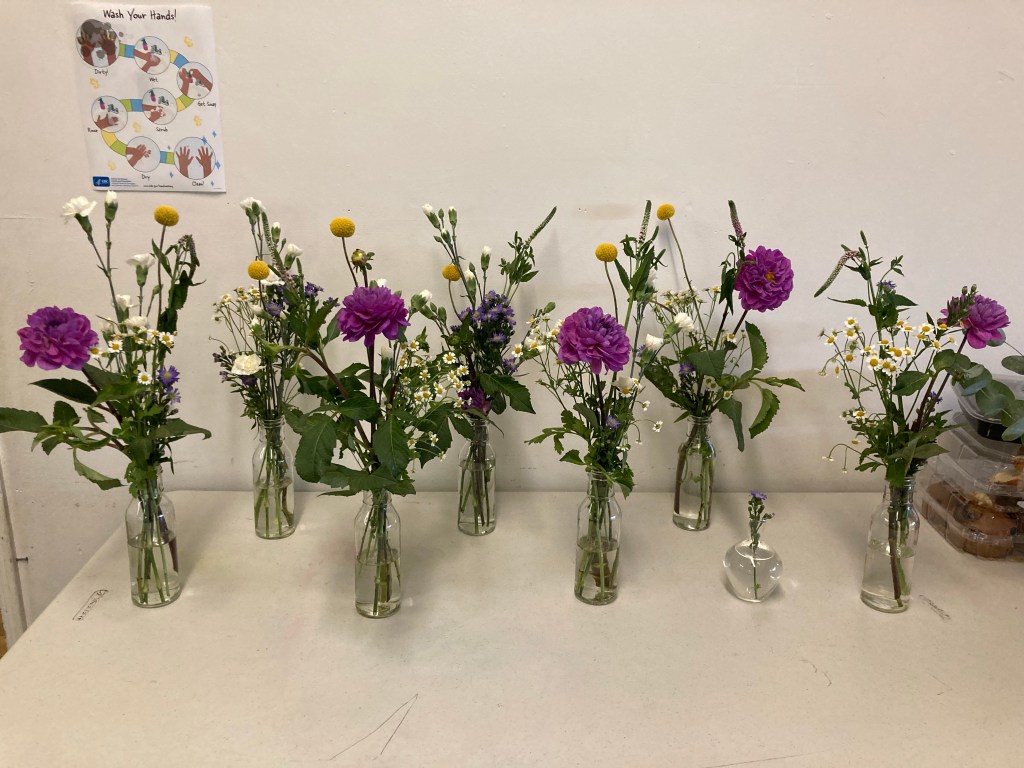
Jenny and Scott Chan’s Wildflower Baby Shower

Trader Joe’s gives you free buckets if you ask.

5 flowers (1 dahlia, 1 spray roses, 1 camomile, 1 long thingy, and 1 yellow boop) and 1 filler eucalyptus coated about $35, which is roughly $5 per bouquet. Didn’t end up needing the eucalyptus.

Can repurpose salad dressing bottles to use as vases. Spray roses make good multi level filler. Certain types of camomile don’t separate well and only look good as small pops of color.

Design a site like this with WordPress.com
Get started